Stephen Dorr Jr. Is Killed In Toronto Airplane Collision |
|
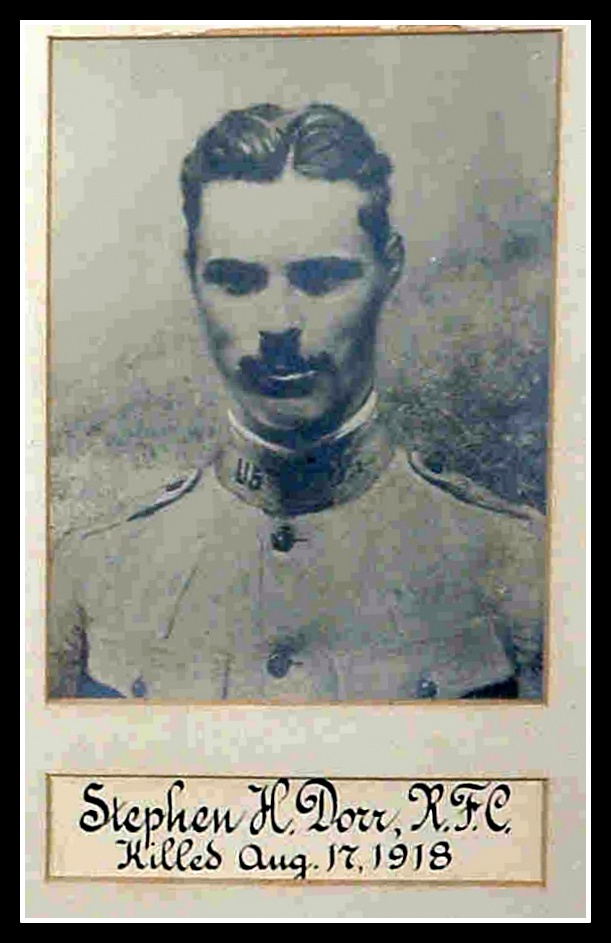 Stephen Higginson Dorr Jr., 24, was killed in an airplane collision in Toronto on
Aug. 17, 1917. The eldest son of Stephen H. Dorr of Satterthwaite Avenue, he
had lived in Nutley all his life. Stephen Higginson Dorr Jr., 24, was killed in an airplane collision in Toronto on
Aug. 17, 1917. The eldest son of Stephen H. Dorr of Satterthwaite Avenue, he
had lived in Nutley all his life.He joined the Officers’ Reserve Corps at Fort Myer several months ago and was one of ten men selected to go to Toronto for training in aviation with the Royal Flying Corps there. Dorr was a graduate of the Princeton Training School. Funeral services for Dorr, the first Nutley son to meet death as a result of the war, were held Monday afternoon at Grace Church. The auditorium was filled with mourners and military honors were paid to the young aviator at both the church and cemetery. Rev. Douglas Matthews conducted the services. The casket was covered with an American flag and was accompanied by Captain John Witney, commander of Squadron A, New York. Witney had served alongside Dorr with the squadron in Mexico. The pallbearers were Joseph O’Neil, brother of Mr. Dorr’s fiancée, Miss Elizabeth O’Neil, Louis O. Ray, Harry S. Bluhm, Julian De Picaza, Welling Nichols, Pearce P. Williams, and Hammatt Norton of Nutley, and Bernard Deslivia of Washington, D.C. At Rosedale Cemetery, Orange, the guard of honor saluted the flag-draped coffin while the bugler sounded taps. According to the Toronto Globe, August 18, 1917 S. H. Dorr, an American cadet training with the Royal Flying Corps., was killed yesterday in an accident at Armour’s Heights. It was Dorr’s first solo flight, and also the first solo flight of another cadet, an American, G. Squires. In some manner the planes collided in the air, Dorr’s falling to the ground, and bursting into flames as soon as it struck the earth. Bystanders extricated him from the machine, but not until he had been severely burned. He died a few minutes later. The other aviator made his landing without mishap, but naturally his nerves were rather shaken. The Globe report cited the rarity of mishaps. The fact that a fatal accident to an Royal Flying Corps man is necessarily rather spectacular is rather inclined to cause people to think that such mishaps occur very often. As a matter of fact, since the Flying Corps opened operations here (in Toronto) last February, deaths from accidents in the air have been under one percent, say Flying Corps officials. In that time, over 1,200 cadets have been flying, and at the present time each squadron flies forty to fifty hours daily. Royal Flying Corps officials here claim that the record of carefulness in the training camps in Canada compares more than favorably with that of England and France. Unfortunately, a mistake in the air is liable to be costly, but the Royal Flying Corps officers claim that a man cannot learn to fly without flying. They point out that the machines and engines are fully inspected before and after every flight by a rigger personally responsible for every machine that goes up.
Florida airfield named According to Florida Aviation and Southwest Florida - 1910 to 1996: Near Arcadia, Carlstrom Field and Dorr Field were principal aviation training stations for the Army. At Dorr Field fourteen hangars were constructed and training was done in Curtiss JN-4D (Jenny) airplanes as well as some rotary engine craft produced by the Glenn Martin company. Army airfields were named after
military aviation heroes of the day, and Carlstrom Field was named after
First Lieutenant Victor Carlstrom who had made many altitude and distance
records and died in a training flight. In 1944 the Embry-Riddle interests were sold to John McKay. After the war, the field was converted to a minimum security prison. Sources The Nutley Sun, August 1917, Aug. 25, 1917 The Toronto Globe, August 18, 1917 Brian Lindner Robert F. Dorr (no relation), author of Air Combat: An Oral History of Fighter Pilots |
Nutley Sons Honor RollWorld War I |
|
Contact Us Snail Mail: PO Box 110252, Nutley NJ 07110Web site created by Anthony Buccino NutleySons.com © 2001 by Anthony Buccino Web Site Sponsor |
|